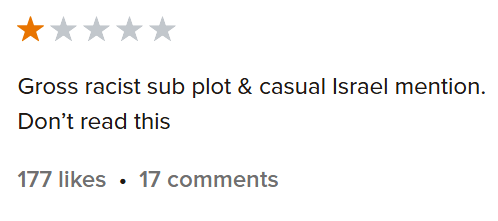
A Goodreads pile-on can start faster than you can finish chapter one. The book doesn’t even have to be published. It can be as simple as a mention of Israel or a Jewish character, a celebrity you don’t like, or an author who has said or not said something. Judgment happens, context disappears, and within hours the verdict is in. The punishment is one-star reviews flooding the book’s Goodreads page and calls for boycotts.
I see the same two arguments repeated over and over on BookTok and Bookstagram. One claims that all reading is political, that every text exists within structures of power and therefore reflects, reinforces, or resists them. The other pushes back, insisting that reading can just be about escapism and joy, asking that politics be left outside the book.
Both perspectives hold truth. Literature has always been shaped by its context. Omission, silence, and neutrality can carry political weight. At the same time, reading is deeply personal. People look for comfort, escape, and imagination, leaving the current political climate outside the pages.
Awareness of context matters. But something has shifted. We now feel free to assign meaning to a book before we’ve even read it.
The problem with the discourse in online reading spaces is what happens next. Authors and books are boycotted based on these assumptions. Is that any better than book burning?
One of the most disturbing trends right now is how quickly authors are labeled, and how little it takes. A character is Jewish. There is a mention of Israel. A white author includes black or brown character in their stories. An author shares something about their background. And suddenly the labels appear: Zionist. Racist. Problematic.
Not because it is the author’s actual stance, but because of association. A mention becomes endorsement. Silence becomes siding with the oppressor. Ambiguity is not accepted. The space for nuance has collapsed.
What happens if authors begin avoiding places, identities, or descriptions for fear of being misread and pre-judged? Why is there this growing expectation that authors must perform their politics publicly?
The reviewing culture has completely lost the plot. Books are rated down en masse before release, and people cheer for boycotts. The reasoning often has nothing to do with the writing, but with the author and what they’ve said or haven’t said.
If we’re not reading the books, what exactly are we reviewing?
Or let me put it this way: If you haven’t read the book, you’re not reviewing it. You’re performing.
Reviews are supposed to be responses to what’s on the page. Now they often function as signals of alignment, identity, and being on the “right side.”
We’ve already seen how quickly this escalates. When Kevin Federline released his memoir You Thought You Knew, public disgust with him and sympathy for Britney Spears shaped the response immediately. The reaction wasn’t just about the book, but about the person behind it.
At a certain point, the volume and intensity of negative reviews on Goodreads became so overwhelming that reviewing was restricted. I know this because I tried to review it myself and couldn’t. I could only change the status between “read” and “want to read.” (I have since published my review on goodreads.)
On other books, you can see how quickly isolated details eclipse the entire work. A single line, a character background, a perceived implication. That becomes the whole conversation. Here are some examples: (and I’m not going to even mention which books they are to avoid more pile-ons!)
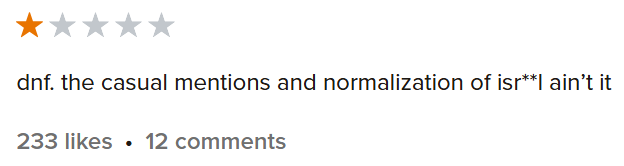
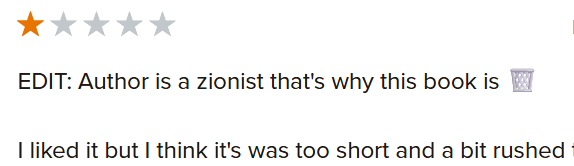
In the the last review it’s clear that someone initially liked the book (I didn’t include the entire review) and then edited it down to one star because “the author is a Zionist.” Not based on the text, but on assumption.
Some of this comes from a good place. Readers care. They want accountability. They want to understand the beliefs behind what they engage with. But the result is often a flattening of both authors and art, and a deepening of polarization rather than understanding.
When authors are judged as much for what they don’t say as for what they write, literature stops being a space for exploration and becomes a test. And that will have consequences. If every detail risks misinterpretation, authors will start avoiding certain topics, identities, and settings altogether. Not out of ignorance, but out of caution. The result will be narrower, safer, and less honest literature.
To say reading is political should invite deeper thinking. But what we’re seeing now isn’t deeper thinking. It’s faster judgment. If every mention is treated as endorsement and every book is judged before it’s read, we are no longer engaging with literature. We are anticipating it. We are deciding what it means before it has the chance to mean anything at all.
And then we lose what makes reading powerful in the first place. It expands perspective. It builds nuance. It slows down judgment. Reading is powerful because it delays judgment and makes space for thought. If you take that away simply because a book contains trigger words, you lose the entire point.
You can’t claim that books matter while refusing to actually read them.

 Marie III